“Where is my package?”
Closing the couriers’ settlement takes you the whole morning.
Every trip is written down somewhere: in the notebook of whoever took the call, in the courier’s WhatsApp, or in the spreadsheet someone filled in during the afternoon. There is no single place where they all are.
And every two weeks you have to cross-check all of it to know how much each courier gets paid and how much you bill each company.
One just like it, running every day
1,656deliveries tracked in the system, across 3,680 documents · SLE Mensajería, Buenos Aires
Marcela has run a courier company in Buenos Aires for eight years, with couriers out on the street every day. She closed the settlement by cross-checking spreadsheets.
I built her a panel with the trips and their tracking, the couriers’ settlement by period and the running account of each business client, with its monthly statement as a PDF. The settlement comes from the same trips that were entered: nobody copies them into another spreadsheet to get them paid.
It used to take me the whole morning to close the settlement, cross-checking spreadsheets. Now I open the panel and close it in 5 minutes. What a change.
Read the whole caseOpen the Yusta Logística demo
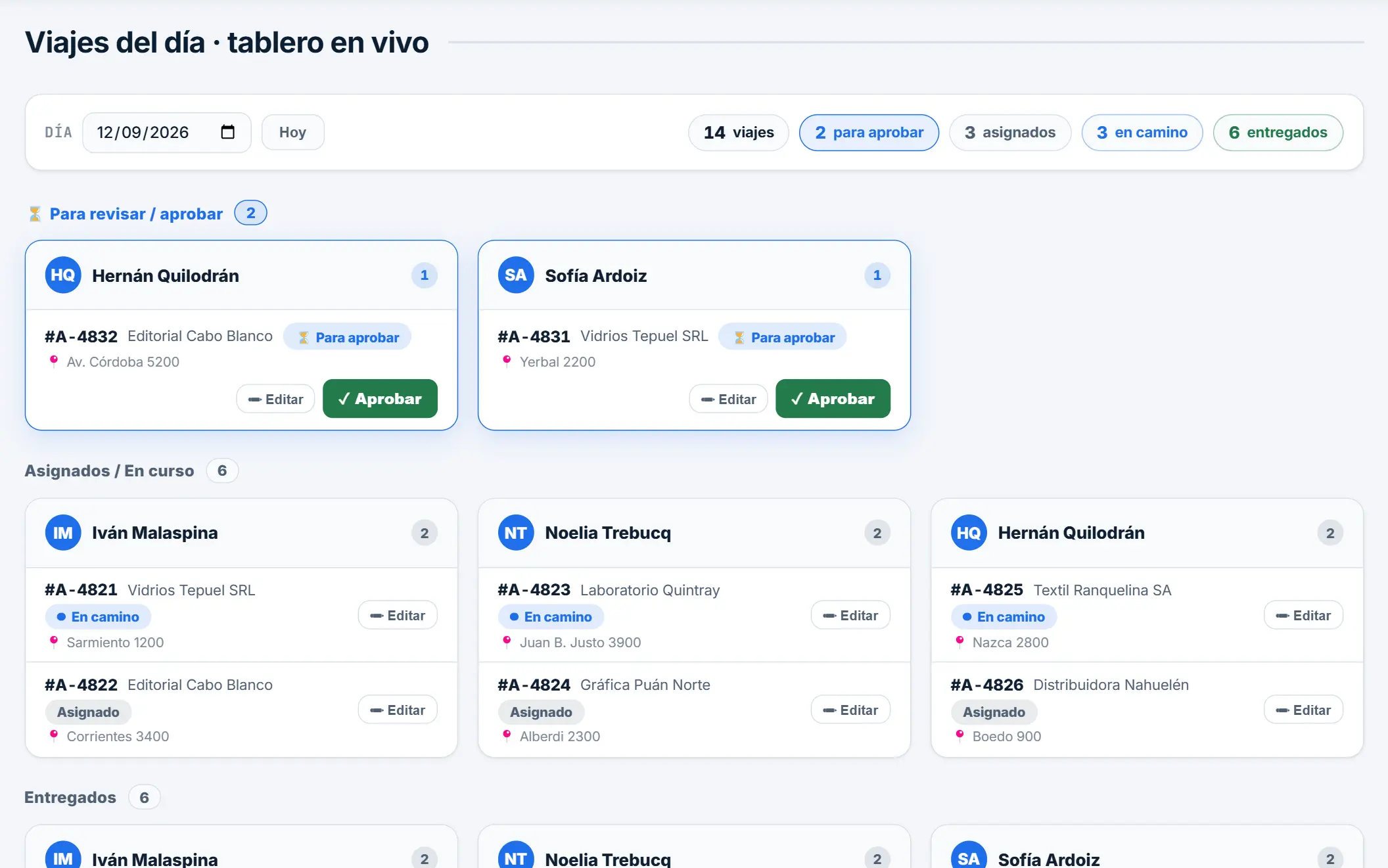
Yusta Logística: Trips, couriers, deliveries and the day’s settlement. The interface is in Spanish today. Which language it ships in is set per build.
What goes into the one for a courier company
Six things, and all six are in the panel Marcela uses:
- The day’s trips with their status, the assigned courier and the vehicle.
- The settlement by period, calculated by the system. Nobody cross-checks trip by trip: that was the step that took the whole morning.
- The running account of each business client, with what they were billed and what they owe.
- Each company’s monthly statement as a PDF, built from the same trips that were entered.
- The full history, filterable and exportable: client, courier, vehicle, payment method and price.
- The month’s cash and a dashboard with what is out on the street right now.
They all start with the same things: users with permissions, a daily cash register, a dashboard with payments and due dates in plain sight, and WhatsApp from the client’s record. You open it from the shop’s computer and from your phone, and the database keeps every minute of the last seven days.
What it costs
From USD 1,000, paid once.
The one I built for SLE Mensajería is in the Intermediate tier: USD 2,000, delivered in 5 to 8 weeks, with 60 days of adjustments and 2 months of maintenance included. Yours depends on how many screens it needs; the quote comes within 24 hours, with the scope in writing.
There’s nothing free for this that works. The hard part is the way you settle accounts, and no spreadsheet downloaded from the internet knows it. What there is plenty of are monthly subscriptions charged per user, and they never stop running.
Here you pay once and there is no monthly subscription. The repository, the domain and the database stay in your account, in your name. See the four tiers
Tell me how you work and I’ll show you the one for a courier company
You write to me and I answer myself. I’m Nicolás Yusta, and I’m also the one who writes the code.
WhatsApp: +54 9 11 2469-3394